Psychoeducation Resources

The Science of Making Friends: Helping Socially Challenged Teens and Young Adults
The groundbreaking book that puts the focus on teens and young adults with social challenges
This book offers parents a step-by-step guide to making and keeping friends for teens and young adults with social challenges―such as those diagnosed with autism spectrum disorder, ADHD, bipolar, or other conditions. With the book’s concrete rules and steps of social etiquette, parents will be able to assist in improving conversational skills, expanding social opportunities, and developing strategies for handling peer rejection.
Each chapter provides helpful overview information for parents; lessons with clear bulleted lists of key rules and steps; and expert advice on how to present the material to a teen or young adult. Throughout the book are role-playing exercises for practicing each skill, along with homework assignments to ensure the newly learned skills can be applied easily to a school, work, or other "real life" setting. Bonus content shows role-plays of skills covered, demonstrating the right and wrong way to enter conversations, schedule get-togethers, deal with conflict, and much more.

On Becoming A Person: A Therapist's View on Psychotherapy, Humanistic Psychology, and the Path to Personal Growth
Carl Rogers, founder of the humanistic psychology movement, revolutionized psychotherapy and the helping relationship with his concept of "client-centered therapy." His influence has spanned decades, but that influence has become so much a part of mainstream psychology that the ingenious nature of his work has almost been forgotten. New discoveries in the field of psychopharmacology, especially that of the antidepressant Prozac, have spawned a quick-fix drug revolution that has obscured the psychotherapeutic relationship. As the pendulum slowly swings back toward an appreciation of the therapeutic encounter and deeper interpersonal relationships, Dr. Rogers’s "client-centered therapy" becomes particularly timely and important.

Atomic Habits: An Easy & Proven Way to Build Good Habits & Break Bad Ones
No matter your goals, Atomic Habits offers a proven framework for improving--every day. James Clear, one of the world's leading experts on habit formation, reveals practical strategies that will teach you exactly how to form good habits, break bad ones, and master the tiny behaviors that lead to remarkable results.
If you're having trouble changing your habits, the problem isn't you. The problem is your system. Bad habits repeat themselves again and again not because you don't want to change, but because you have the wrong system for change. You do not rise to the level of your goals. You fall to the level of your systems. Here, you'll get a proven system that can take you to new heights.

Attached: The New Science of Adult Attachment and How It Can Help You Find—and Keep—Love
We already rely on science to tell us what to eat, when to exercise, and how long to sleep. Why not use science to help us improve our relationships? In this revolutionary book, psychiatrist and neuroscientist Dr. Amir Levine and psychologist Rachel Heller scientifically explain why some people seem to navigate relationships effortlessly, while others struggle through adult attachment. Pioneered by psychologist John Bowlby in the 1950s, the field of attachment posits that everyone behaves in one of three distinct ways while in a relationship:
• Anxious people are often preoccupied with their relationships and tend to worry about their partner's ability to love them back
• Avoidant people equate intimacy with a loss of independence and constantly try to minimize closeness
• Secure people feel comfortable with intimacy and are usually warm and loving

The Denial of Death
Winner of the Pulitzer Prize in 1974 and the culmination of a life’s work, The Denial of Death is Ernest Becker’s brilliant and impassioned answer to the “why” of human existence. In bold contrast to the predominant Freudian school of thought, Becker tackles the problem of the vital lie—man’s refusal to acknowledge his own mortality. In doing so, he sheds new light on the nature of humanity and issues a call to life and its living that still resonates decades after its writing.

How to Win Friends and Influence People
One of the best-known motivational guides in history, Dale Carnegie’s groundbreaking publication has sold tens of millions of copies, been translated into almost every known written language, and has helped countless people succeed.
Carnegie’s rock-solid, experience-tested advice has remained relevant for generations because he addresses timeless questions about the art of getting along with people. How to Win Friends and Influence People teaches you:
-How to communicate effectively
-How to make people like you
-How to increase your ability to get things done
-How to get others to see your side
-How to become a more effective leader
-How to successfully navigate almost any social situation
-And so much more!
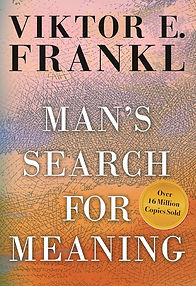
Man's Search for Meaning
This seminal book, which has been called “one of the outstanding contributions to psychological thought” by Carl Rogers and “one of the great books of our time” by Harold Kushner, has been translated into more than fifty languages and sold over sixteen million copies. “An enduring work of survival literature,” according to the New York Times, Viktor Frankl’s riveting account of his time in the Nazi concentration camps, and his insightful exploration of the human will to find meaning in spite of the worst adversity, has offered solace and guidance to generations of readers since it was first published in 1946. At the heart of Frankl’s theory of logotherapy (from the Greek word for “meaning”) is a conviction that the primary human drive is not pleasure, as Freud maintained, but rather the discovery and pursuit of what the individual finds meaningful. Today, as new generations face new challenges and an ever more complex and uncertain world, Frankl’s classic work continues to inspire us all to find significance in the very act of living, in spite of all obstacles.

Mastery
Each one of us has within us the potential to be a Master. Learn the secrets of the field you have chosen, submit to a rigorous apprenticeship, absorb the hidden knowledge possessed by those with years of experience, surge past competitors to surpass them in brilliance, and explode established patterns from within. Study the behaviors of Albert Einstein, Charles Darwin, Leonardo da Vinci and the nine contemporary Masters interviewed for this book.

Letters From A Self-Made Merchant To His Son
George Horace Lorimer was an American journalist and author. He is best known as the editor of The Saturday Evening Post. His Letters From A Self-Made Merchant To His Son is a timeless collection of Gilded Age aphorisms from a rich man - a prosperous pork-packer in Chicago to his son, Pierrepont, whom he ‘affectionately’ calls ‘Piggy.’ The writing is subtle and brilliant.

Designing Your Life: How to Build a Well-Lived, Joyful Life
Designers create worlds and solve problems using design thinking. Look around your office or home—at the tablet or smartphone you may be holding or the chair you are sitting in. Everything in our lives was designed by someone. And every design starts with a problem that a designer or team of designers seeks to solve.
In this book, Bill Burnett and Dave Evans show us how design thinking can help us create a life that is both meaningful and fulfilling, regardless of who or where we are, what we do or have done for a living, or how young or old we are. The same design thinking responsible for amazing technology, products, and spaces can be used to design and build your career and your life, a life of fulfillment and joy, constantly creative and productive, one that always holds the possibility of surprise.

The Subtle Art of Not Giving a F*ck: A Counterintuitive Approach to Living a Good Life
For decades, we’ve been told that positive thinking is the key to a happy, rich life. "F**k positivity," Mark Manson says. "Let’s be honest, shit is f**ked and we have to live with it." In his wildly popular Internet blog, Manson doesn’t sugarcoat or equivocate. He tells it like it is—a dose of raw, refreshing, honest truth that is sorely lacking today. The Subtle Art of Not Giving a F**k is his antidote to the coddling, let’s-all-feel-good mindset that has infected modern society and spoiled a generation, rewarding them with gold medals just for showing up.

Unwritten Rules of Social Relationships: Decoding Social Mysteries Through the Unique Perspectives of Autism
Born with autism, both Temple Grandin and Sean Barron now live famously successful social lives. However, their paths were quite different. Temple's logical mind controlled her social behavior. She interacted with many adults and other children, experiencing varied social situations. Logic informed her decision to obey social rules and avoid unpleasant consequences. Sean's emotions controlled his social behavior. Baffled by social rules, isolated and friendless, he made up his own and applied them to others. When they inevitably broke his rules, he felt worthless and unloved. Both Temple and Sean ultimately came to terms with the social world and found their places in it. Whether you are a person with autism, a caregiver in the autism community, or just someone interested in an outsider view of society, their powerful stories will enthrall and enlighten you.

The Autobiography of Benjamin Franklin
Benjamin Franklin’s Autobiography is the blueprint for self‑made success. Penned between 1771 and 1790, this unfinished memoir lays bare the journey of an ambitious printer’s son who used grit, curiosity, and moral rigor to become a scientist, inventor, diplomat, and one of America’s greatest statesmen.

A Beginner's Guide to the End: Practical Advice for Living Life and Facing Death
Theirs is a clear-eyed and big-hearted action plan for approaching the end of life, written to help readers feel more in control of an experience that so often seems anything but controllable. Their book offers everything from step-by-step instructions for how to do your paperwork and navigate the healthcare system to answers to questions you might be afraid to ask your doctor, like whether or not sex is still okay when you’re sick. Get advice for how to break the news to your employer, whether to share old secrets with your family, how to face friends who might not be as empathetic as you’d hoped, and how to talk to your children about your will. (Don’t worry: if anyone gets snippy, it’ll likely be their spouses, not them.) There are also lessons for survivors, like how to shut down a loved one’s social media accounts, clean out the house, and write a great eulogy.

King, Warrior, Magician, Lover: Rediscovering the Archetypes of the Mature Masculine ― A Classic Jungian Psychology Guide to Shadow Work
The classic guide to the four essential male archetypes.
Masculinity is on trial, leaving many men feeling lost, threatened, or unable to clearly express themselves. Instead of leading to internal growth and maturity, paradigms like “toxic masculinity” and “man up!” ultimately lead to men and boys feeling isolated, angry, and unable to hold steady and healthy relationships—with themselves and others. King, Warrior, Magician, Lover dispels these and other common myths and stereotypes and offers a new framework from the field of masculine psychology for understanding men and their many facets—and the societal and emotional factors that make us who we are.

Breath: The New Science of a Lost Art
There is nothing more essential to our health and well-being than breathing: take air in, let it out, repeat twenty-five thousand times a day. Yet, as a species, humans have lost the ability to breathe correctly, with grave consequences.
Journalist James Nestor travels the world to figure out what went wrong and how to fix it. The answers aren’t found in pulmonology labs, as we might expect, but in the muddy digs of ancient burial sites, secret Soviet facilities, New Jersey choir schools, and the smoggy streets of São Paulo. Nestor tracks down men and women exploring the hidden science behind ancient breathing practices like Pranayama, Sudarshan Kriya, and Tummo and teams up with pulmonary tinkerers to scientifically test long-held beliefs about how we breathe.
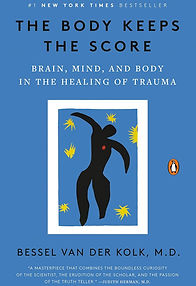
The Body Keeps the Score: Brain, Mind, and Body in the Healing of Trauma
Trauma is a fact of life. Veterans and their families deal with the painful aftermath of combat; one in five Americans has been molested; one in four grew up with alcoholics; one in three couples have engaged in physical violence. Dr. Bessel van der Kolk, one of the world’s foremost experts on trauma, has spent over three decades working with survivors. In The Body Keeps the Score, he uses recent scientific advances to show how trauma literally reshapes both body and brain, compromising sufferers’ capacities for pleasure, engagement, self-control, and trust. He explores innovative treatments—from neurofeedback and meditation to sports, drama, and yoga—that offer new paths to recovery by activating the brain’s natural neuroplasticity. Based on Dr. van der Kolk’s own research and that of other leading specialists, The Body Keeps the Score exposes the tremendous power of our relationships both to hurt and to heal—and offers new hope for reclaiming lives.