The Coaching Leader: How Coaching Leadership Style Transforms Teams in 2026
- ultra content
- 1 hour ago
- 10 min read

A coaching leader is someone who uses coaching conversations to help their team members think critically, develop their abilities, and own their outcomes—rather than simply issuing directives or providing solutions. This leadership style has surged since around 2020, particularly as the shift to hybrid work demanded new ways of influencing and supporting people without constant physical presence.
The global leadership coaching market is projected to reach $20 billion by 2032, signalling that coaching leadership is now mainstream. Organizations with strong coaching cultures are twice as likely to be high-performing. The results speak for themselves: higher employee engagement, better retention, stronger innovation, and a reliable pathway for developing future leaders.
In this article, you’ll find a practical framework, core principles, and concrete examples you can apply immediately. Whether you’re new to the coaching approach or looking to deepen your practice, this guide will help you lead with greater impact in 2026 and beyond.
What Is Coaching Leadership Style? Core Definition and Mindset
Coaching leadership style is a way of leading that prioritises development, ownership, and continuous learning. It shifts the leader’s role from expert or fixer to facilitator of thinking—helping people discover their own insight and solutions.
Coaching leadership empowers team members by shifting from a top-down approach to one that focuses on guidance, support, and personal development. Consider a 2026 tech company scenario: a manager notices a product roadmap delay. Instead of dictating which features to prioritise, they ask, “What assumptions underpin your current priorities, and how might shifting one unlock progress?” This question-led approach builds capability and confidence rather than dependency.
How coaching leaders operate:
Focus on strengths and growth potential rather than just fixing weaknesses
Ask open-ended questions that stimulate self reflection and critical thinking
Work within the coachee’s agenda instead of imposing their own priorities
Encourage accountability by guiding team members to set their own goals
Unlike traditional command-and-control leadership, which yields short-term compliance but fosters dependency, coaching leadership builds long-term performance and intrinsic motivation. It also differs from mentoring or consulting—both of which give advice from experience—because coaching insists on the person discovering their own path forward.
A coaching leader often asks thoughtful, open-ended questions to encourage self reflection and critical thinking, helping team members explore their ideas and solutions. This approach can blend with other styles (directive, supportive, delegating) depending on context, but its baseline is empowerment and growth.
When a Coaching Style Works – And When It Doesn’t
Effective leaders know when to use a coaching style and when another approach is more appropriate. Coaching leadership isn’t a universal solution—it’s one tool in a broader toolkit.
When coaching leadership style works well:
Skill development for mid-level performers ready to stretch
Navigating performance plateaus where a person needs to find new ideas
Innovation projects requiring creativity and risk taking
Building long-term employee engagement and ownership
When a coaching style may not work:
Urgent crises requiring immediate directives (e.g., a cybersecurity breach)
Strict safety or compliance contexts where delays risk catastrophe
Brand-new hires who need clear direction before coaching
Serious misconduct or repeated underperformance requiring performance management
Think of it this way: coaching an experienced analyst through a complex client problem can accelerate resolution by 50%, as they own the process and develop new skills. But during a live security incident, directive intervention is essential to prevent data loss.
Situational leadership theory suggests assessing task-specific readiness: coaching for high-readiness development, directing for low-readiness execution.
The Coaching Conversation Framework: From Insight to Action

A simple, memorable framework can help you lead coaching conversations without needing all the answers. Beyond the Explore–Expand–Execute model, leaders can also draw on the top coaching model frameworks for 2026 to structure conversations around the coachee’s agenda, making each session productive and development-focused.
This framework fits into 20–40 minute one on one sessions, whether in person or on video calls—ideal for modern hybrid schedules. Let’s break down each phase.
Explore – Where Are They Now?
This first phase focuses on understanding the coachee’s current reality, goals, emotions, and constraints before offering any solutions.
Start with curiosity and active listening: “What outcome matters most to you in Q3 2026?” or “What have you tried so far?”
Avoid jumping in with advice—instead, reflect back what you hear to build self awareness and build trust
Use silence (up to 10 seconds) and follow-up questions to help the person clarify their thinking
Keep the focus on their agenda, not your assumptions about what matters
Expand – What Else Is Possible?
This phase safely challenges assumptions, explores options, and widens perspective without criticism. Effective coaching involves creating a safe and supportive environment while also challenging individuals to stretch their thinking and explore new possibilities.
Help the person reframe limiting beliefs: “If there were no budget constraints, what would you try?”
Blend support and challenge—reinforce confidence while stretching thinking
Ask questions like: “What patterns emerge from past successes?” or “What would you advise a colleague in this situation?”
Stimulate creativity around real workplace issues such as remote collaboration or cross-functional projects
Execute – What Will You Do Next?
Invite the person to choose their next steps, timelines, and success measures
Ask: “What precise step will you own by May 25, 2026, and how will we measure it?”
Schedule a follow-up check-in to review progress and learning
Provide encouragement and resources while keeping responsibility with the coachee
Encouraging autonomy in team members can improve accountability and confidence. The leader’s role is to support, not to prescribe.
Example: A leader coaches a direct report through an AI implementation rollout. In Explore, they surface frustrations about adoption. In Expand, they ask, “What if we piloted with one remote team first?” In Execute, they agree: “Launch prototype by June 1, debrief June 15.”
Six Core Principles of Effective Coaching Leaders

Beyond any model, coaching leaders rely on foundational principles that shape every interaction. These principles underpin the Explore–Expand–Execute framework and make coaching conversations genuinely developmental.
Create a Safe, Supportive – and Challenging – Environment
Coaching leaders balance psychological safety with stretch. People need to feel secure enough to take risks and honest enough to hear challenge.
Schedule consistent one on one sessions with confidentiality and non-judgmental questions
React calmly to mistakes—focus on learning, not blame
Introduce healthy challenge by gently pushing for bolder goals or asking for evidence behind assumptions
Promoting a growth mindset involves encouraging team members to view challenges as opportunities for development. For example, after a failed launch, a leader might ask, “What did that teach us? What bolder experiment could we try next quarter?” Research from Google’s Project Aristotle found teams with psychological safety show 28% higher innovation.
Work Within the Coachee’s Agenda
Effective coaching leadership keeps the focus on what matters most to the coachee, not solely on the leader’s priorities.
Contract at the start: “What would make this 30 minutes most valuable for you?”
Stay anchored to that agenda throughout the conversation
When organisational needs must take priority, explicitly switch hats from coach to manager to protect trust
Coaching leaders should work within the coachee’s agenda, allowing them to decide which goals to work on, which helps preserve trust and effectiveness in the coaching relationship. This principle directly supports ownership, motivation, and more sustainable employee engagement.
Facilitate and Collaborate Instead of Fixing
A coaching leader fosters a culture of continuous improvement by encouraging open communication, collaboration, and mutual respect among team members.
Ask questions, summarise, and invite options rather than jumping in with solutions
Use active listening techniques: paraphrasing, reflecting emotions, checking understanding
Minimise storytelling and advice unless explicitly requested
Imagine a team member struggling with a client issue. Instead of giving the answer, a coaching leader helps them design their own action plan—building their skills and confidence for future challenges.
Advocate Self-Awareness for Leader and Coachee
Coaching leaders continually develop their own self awareness and help others do the same. Leaders who are self-aware, empathetic, and emotionally grounded are better positioned to build trust and handle pressure effectively.
Use practical tools: 360° feedback platforms, reflection prompts after key meetings, noticing emotional triggers in real time
Model vulnerability by sharing one development goal you’re actively working on
Help team members ask: “What triggered that reaction?” to deepen their own insight
Promote Learning from Real Experience
Coaching leadership turns everyday work events into ongoing learning opportunities. Promoting learning from experience is crucial in coaching, as it helps individuals reflect on past events and analyze what went well and what didn’t, fostering continuous improvement.
Use simple debrief structures after projects: “What went well? What surprised you? What will you do differently in the next sprint?”
Reduce fear of mistakes by normalising reflection and experimentation
Show people their experiences and insight are valued, not ignored—boosting engagement and adaptability
Model the Behaviours You Coach
Coaching leaders must embody the behaviours they ask from others: curiosity, accountability, openness to feedback, and a growth mindset.
In meetings, visibly apply coaching skills: invite quieter voices, ask open questions, resist jumping to solutions
Acknowledge limits and signpost team members to additional mentors or executive coach resources when appropriate
Demonstrate that words and actions align—this builds trust and accelerates culture change towards a genuine coaching culture
Essential Coaching Skills Every Leader Needs in 2026
Coaching skills are now core leadership skills, not specialist add-ons—especially in knowledge work and hybrid teams. Here are the capabilities every leader should develop:
Active Listening Effective coaching leadership involves active listening and asking open-ended questions to promote self reflection and critical thinking among team members. Try this: In your next one-to-one, paraphrase what your team member says before responding. “It sounds like you’re frustrated by the lack of clarity—am I hearing that right?”
Powerful Questioning Ask future-focused, open questions: “What’s the next step you’re considering?” or “What would success look like by the end of Q3?” Avoid leading questions that reveal your preferred answer.
Constructive Feedback Coaching leadership emphasizes the importance of providing constructive feedback that acknowledges successes while also identifying areas for growth. Use the SBI model: describe the Situation, the Behaviour you observed, and the Impact it had. Balance helpful feedback with recognition of strengths.
Emotional Intelligence in Action Emotional intelligence (EI) is central to effective leadership, enabling leaders to connect, influence, and inspire their teams. Coaching sharpens emotional intelligence by helping leaders develop self awareness and empathy, which are essential for managing emotions in themselves and others.
Developing these skills supports both effective coaching and broader effective leadership across the organisation. Practice them in everyday conversations—not just formal sessions.
Business Impact: Why Coaching Leaders Drive Performance and Engagement
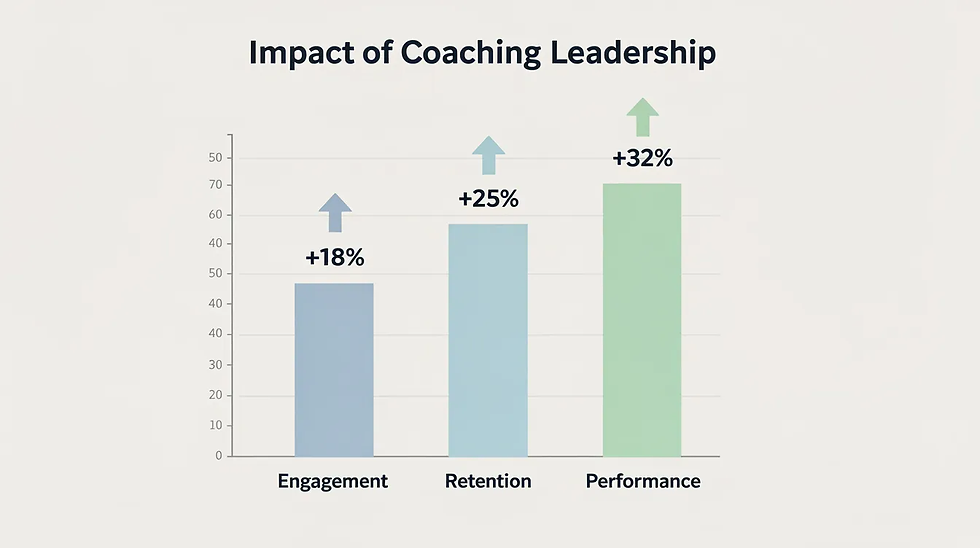
Leaders who adopt a coaching style can significantly increase employee engagement, as employees feel valued and motivated when their development is prioritized.
Coaching fosters a culture of innovation and performance by encouraging employees to think critically and creatively, leading to improved overall performance.
A coaching approach helps develop future leaders by mentoring employees and building their skills and confidence, creating a pipeline of talent for the organization.
Research indicates coached firms see 21% higher engagement and 15–20% retention gains.
Teams with coaching leaders report fewer escalations and stronger problem-solving, reducing cognitive load for senior leadership.
Mini-case: A global tech company that adopted Co-Active coaching training post-2024 reported a 35% performance uplift and stronger leadership pipelines. In fast paced environments where AI commoditizes routine tasks, coaching leadership amplifies uniquely human creativity and adaptability.
Developing Coaching Leaders and a Coaching Culture in Your Organisation

There’s a difference between isolated coaching leaders and an embedded coaching culture that supports them. Building sustainable capability requires intentional investment.
Steps to develop coaching leaders and culture:
Launch leadership coaching programs and manager training in coaching skills (e.g., a 6-month cohort in 2026)
Establish peer coaching circles for ongoing practice and support
Integrate coaching into performance conversations and leadership development
Pilot with a small group, measure outcomes, and scale based on feedback
Senior leadership role-modelling is essential. When executives demonstrate curiosity, ask coaching questions in meetings, and debrief openly, it signals that coaching is valued.
Examples of coaching culture in daily practice:
Debrief rituals after projects (“What did we learn? What will we do differently?”)
Coaching questions embedded in team meetings
Internal coach networks connecting leader coaches across business units
FAQs about Coaching Leaders
How much time does it really take to lead with a coaching style?
Coaching-style leadership often fits into existing one-to-ones and project check-ins, typically adding only 5–10 minutes per conversation when done consistently. Deeper coaching conversations (20–40 minutes) can be scheduled monthly or quarterly for key team members rather than weekly for everyone.
Over time, coaching reduces escalations and rework, often saving leaders significant time as team members become more autonomous. Start small: choose one meeting per week to intentionally practise the Explore–Expand–Execute framework. What feels time consuming initially pays dividends in team capability.
What if my team just wants answers, not coaching questions?
Some employees, especially those used to directive leadership, may initially find a coaching style unfamiliar or even frustrating. Explain the “why” behind your approach: the goal is to build their capability and independence, not to withhold help.
Blend styles when needed—answer urgent questions directly, but create space to coach around patterns, decision making, and growth. Ask permission: “Can I coach you through this rather than just give the answer?” This builds buy-in step by step and respects different preferences.
Can new managers become effective coaching leaders quickly?
Coaching leadership is a skillset and mindset that new managers can start building from their early days in role. Focus first on a few core behaviours: active listening, asking open questions, and giving balanced, constructive criticism alongside recognition.
New managers benefit from seeking their own coaching or mentoring—experiencing effective coaching from the coachee perspective accelerates learning. Consistent practice over 6–12 months can significantly shift how their team experiences their leadership, helping them develop into best coaches for their own team.
How do I measure whether my coaching leadership is working?
Track both quantitative and qualitative indicators: engagement scores, retention data, performance metrics, and direct feedback from team members. Ask your team every few months how helpful coaching conversations have been and what could improve.
Observe behavioural changes: more initiative, better cross-team collaboration, fewer repeated issues requiring leader intervention, and stronger team dynamics. Keep a simple personal log of coaching conversations and outcomes across 2025–2026 to reflect on your progress and identify patterns.
Conclusion: The Future Belongs to Coaching Leaders
Coaching leadership style is becoming the default expectation for effective leadership in 2026 and beyond. Organizations need leaders who can develop high performing teams, support organizational change, and unlock the full potential of every person they lead—not just those who can give orders.
The many advantages of coaching leadership compound over time: stronger engagement, better retention, a culture of continuous growth and development, and a pipeline of future leaders ready to succeed in leadership roles. A coaching leader combines the right mindset, core coaching skills, and practical frameworks to create real impact.
You don’t need to master everything at once. Experiment with one or two coaching behaviours in your next conversation—perhaps a powerful question or a moment of genuine active listening. The process of becoming an effective leader who coaches is itself a journey of growth.
Read more articles on leadership development to continue building your knowledge and skills. The future belongs to leaders who ask better questions—and who help their teams find their own answers.