Idealization–Devaluation: Understanding the Narcissistic Abuse Cycle

You match with someone on a dating app. Within a week, they’re texting you constantly, calling you their soulmate, and making plans for a future together. You feel like you’ve finally found the person you’ve been waiting for. Then, without warning, everything shifts. The compliments turn to criticism. The attention becomes withdrawal. Suddenly, you can’t seem to do anything right—and you’re left wondering what happened to the relationship that felt so perfect just days ago.
This pattern—moving from intense adoration to cold dismissal—is what psychologists call idealization and devaluation. In plain terms, it’s the swing from putting someone on a pedestal to treating them as worthless or fundamentally flawed. While minor versions of this exist in normal human relationships, the extreme and repetitive form creates serious damage.
The idealization-devaluation cycle is a common pattern observed in individuals with borderline personality disorder (BPD) and narcissistic personality disorder, where they oscillate between viewing others as perfect and then as completely flawed. However, these patterns also appear in generally unhealthy relationship dynamics where no formal diagnosis exists.
This cycle can erode self worth, create powerful trauma bonds, and lead to long-term struggles with anxiety, depression, and symptoms resembling complex PTSD. If you’ve ever felt like you were walking on eggshells, desperately trying to return to the “good times” with a partner, friend, or family member, you may have experienced this dynamic firsthand.
In this article, you’ll learn how the cycle works—including the devaluation stage that often catches people off guard—why splitting functions as a defense mechanism, classic warning signs to watch for, and concrete steps to protect yourself and begin healing.
What Does Idealization Mean in Psychology?
Idealization is a psychological process where a person attributes exaggerated positive qualities to another person or thing, often as a way to cope with anxiety and emotional conflicts in relationships. Instead of seeing someone as a complex human being with both strengths and flaws, idealization paints them as perfect, incapable of wrongdoing, and almost too good to be true.
In early romantic relationships, idealization can look like:
Constant texting and communication that feels overwhelming but exciting
Intense compliments about your appearance, personality, and character
Rapid sharing of deep secrets and personal history
Talk of exclusive commitment, moving in together, or marriage within days or weeks
Statements like “I’ve never felt this way about anyone” or “You’re different from everyone else”
This intensity often characterizes the honeymoon period of new relationships. Some degree of idealization is normal during early infatuation—you’re naturally focused on your new partner’s positive qualities and overlooking minor flaws. The brain’s reward systems are active, flooding you with dopamine and creating feelings of euphoria.
However, idealization becomes problematic when it ignores obvious red flags, involves pressure for rapid commitment, or turns into a pattern across multiple relationships. Individuals who engage in idealization may view another person as perfect and incapable of wrongdoing, which can lead to unrealistic expectations and eventual disappointment.
In borderline personality disorder and narcissistic personality disorder, idealization often functions as part of splitting—where people or situations are seen as entirely good or entirely bad, with no middle ground. The important person in your life becomes your savior, your soulmate, the answer to all your problems.
A concrete example: In 2023, a woman meets a man through Tinder. After just three dates, he calls her his “soulmate,” shares his deepest traumas, and pushes for exclusivity. He sends 50+ messages daily, plans a joint vacation, and tells her he’s never been so certain about anyone. From the outside, this looks like intense attraction. But this love bombing—the overwhelming amount of attention and affection—often masks deeper issues. The idealization stage sets up a relationship where one partner becomes emotionally dependent while the other maintains control through the intensity of their attention.
Idealization can serve as a defense mechanism, allowing individuals to maintain a fantasy of perfection in relationships, thereby reducing anxiety associated with potential conflicts or disappointments. But this fantasy cannot last. When reality inevitably intrudes—when flaws appear, when conflicts arise, when the other person fails to meet impossible standards—the shift dramatically changes everything.
What Is Devaluation and the Devaluation Stage?
Devaluation is a defense mechanism where a person characterizes themselves, an object, or another person as completely flawed or worthless, often following a period of idealization. Where idealization assigned exaggerated positive qualities, devaluation now assigns exaggerated negative qualities—minimizing anything good and amplifying every perceived flaw.
The devaluation stage in a narcissistic abuse cycle typically begins gradually. The same partner who once called you perfect now seems irritated by your presence. The compliments stop. Criticism takes their place. You might notice:
Sudden coldness or emotional withdrawal
Sarcasm, nitpicking, and criticism about things that never bothered them before
Silent treatment lasting hours or days
Gaslighting—making you question your own memories and perceptions
Rewriting relationship history (“I never said that” or “You’re remembering it wrong”)
Triangulation—comparing you unfavorably to exes, coworkers, or new people
Blame-shifting where every conflict becomes your fault
During the devaluation phase, individuals may become critical, dismissive, and potentially emotionally or verbally abusive towards their partner, leading to feelings of isolation and confusion. The transition from love bombing to devaluation in narcissistic relationships can leave partners feeling confused and isolated as the narcissist becomes critical and dismissive.
How victims typically respond:
The devaluation stage creates a specific pattern of victim behavior. When the person you love suddenly treats you as the problem, you naturally try to fix things. Common responses include:
Over-apologizing for things you didn’t do
Walking on eggshells to avoid triggering anger or disappointment
Working harder to “earn back” the love bombing phase
Making excuses for your partner’s behavior
Isolating from friends and family who might question the relationship
Experiencing cognitive dissonance—holding two conflicting beliefs simultaneously (“they love me” and “they’re hurting me”)
The shift from idealization to devaluation can occur rapidly, often triggered by feelings of disappointment or perceived threats, making it difficult for individuals to maintain stable relationships. A narcissist feels threatened when their partner shows independence, sets boundaries, or fails to provide enough attention. What feels like abandonment or criticism to them—even when it isn’t—can trigger an immediate flip from idealization to devaluation.
It’s important to understand that the devaluation stage is not a normal rough patch. Every relationship has conflicts and difficult periods. But devaluation represents a pattern of control and emotional harm that gradually escalates. The victim is kept off-balance, never knowing which version of their partner they’ll encounter.
Splitting as a Defense Mechanism: Why the Extreme Shifts Happen
Splitting is a defense mechanism characterized by the inability to hold two opposing thoughts, beliefs, or feelings simultaneously, often leading individuals to view others in black-and-white terms. Rather than recognizing that a person can be both loving and frustrating, kind and sometimes thoughtless, splitting forces everything into polar extremes: all good or all bad.
This defense mechanism develops as a way to manage overwhelming emotions. When feelings are too intense or confusing, categorizing the world into simple binaries reduces anxiety. The problem arises when splitting persists into adulthood and repeatedly damages interpersonal relationships.
Origins in trauma and attachment:
The tendency to split can stem from past trauma, such as experiences of abuse or abandonment, which can negatively impact a person’s ability to maintain balanced relationships later in life. When a child experiences inconsistent caregiving—a parent who alternates between warmth and rejection, for example—they learn that relationships are unpredictable and unsafe.
Research on attachment theory, pioneered by John Bowlby, shows that these early experiences shape how we relate to others throughout life. Children who couldn’t trust their caregivers to be consistent often develop insecure attachment styles. The defenses they needed to survive childhood—including splitting—carry forward into adult relationships.
Individuals who engage in splitting may oscillate between idealizing and devaluing others as a way to protect themselves from emotional pain and perceived threats in relationships. In some cases, this can overlap with persecutory projection, where unacceptable feelings are falsely attributed to others, further fueling paranoia and conflict. If you idealize someone completely, you can avoid the anxiety of seeing their flaws. If you devalue them completely, you can protect yourself from the pain of potential rejection.
The brain’s role:
While avoiding heavy neuroscience, it’s worth noting that trauma affects brain development and function. Individuals with histories of early trauma often show heightened amygdala reactivity—the brain’s alarm system fires more easily—and challenges with emotional regulation systems in the prefrontal cortex. This neurological pattern makes it harder to pause, reflect, and see nuance when emotions run high.
Splitting, a defense mechanism often seen in BPD, involves the inability to hold two opposing views of a person, leading to rapid shifts between idealization and devaluation based on emotional triggers. Something as minor as a perceived slight—an unreturned text, a distracted comment—can trigger a complete reversal in how someone views their partner.
Differentiating normal emotions from problematic splitting:
Everyone has moments of intense emotions and sees things in black and white thinking temporarily. After a fight, you might feel like your partner is the worst person alive. That’s normal. The key differences with problematic splitting are:
Normal Emotional Reactions | Problematic Splitting |
Temporary, tied to specific conflicts | Persistent pattern across relationships |
You can eventually see the other person’s perspective | Views remain rigid and extreme |
Emotions calm down with time and distance | Requires a complete flip to the opposite extreme |
Doesn’t fundamentally damage relationships | Repeatedly destroys relationships |
You can hold complexity (“I’m angry but I still love them”) | Cannot integrate good and bad views |
Breaking the patterns of splitting involves moving from “black-and-white” thinking to a “both-and” perspective that acknowledges human complexity. A person can be both loving and capable of making mistakes. A relationship can be both imperfect and worth maintaining. This nuanced view—when it becomes accessible—represents significant psychological growth. |
If you recognize persistent splitting in yourself or someone close to you, this is a clear signal to seek professional mental health support. Reading about what to expect from therapy and how the process works can make taking that first step feel more manageable. This pattern, while deeply ingrained, can change with appropriate therapy and consistent effort.
Idealization and Devaluation in Narcissistic Abuse
Narcissistic abuse is a pattern of manipulation, entitlement, and lack of empathy that causes emotional, psychological, and sometimes financial harm. It’s not about occasional selfishness or conflict—it’s about a sustained dynamic where one person systematically exploits and diminishes another.
Understanding narcissism requires recognizing that individuals with narcissistic traits or full narcissistic personality disorder often struggle to see others as separate, complete people. Instead, others exist as sources of narcissistic supply—attention, admiration, validation, and control that feed the narcissist’s fragile ego.
The Idealize-Devalue-Discard-Hoover Cycle:
The classic narcissistic abuse cycle has four stages:
1. Idealization (Love Bombing)
Overwhelming attention and affection
Future-faking: promises of commitment, shared dreams, “forever” talk
Creating a sense of being uniquely special and understood
Moving the relationship forward at an intense pace
2. Devaluation
Gradual or sudden criticism and emotional withdrawal
Gaslighting, projection of their own flaws onto you
Using your vulnerabilities against you
Triangulation with others to create jealousy and insecurity
Making you feel responsible for their moods and behaviors
3. Discard
Abrupt ending of the relationship, often through cheating, ghosting, or replacement with new supply
May occur when the narcissist makes a determination that you’re no longer useful
Leaves the victim confused, devastated, and often blaming themselves
4. Hoovering
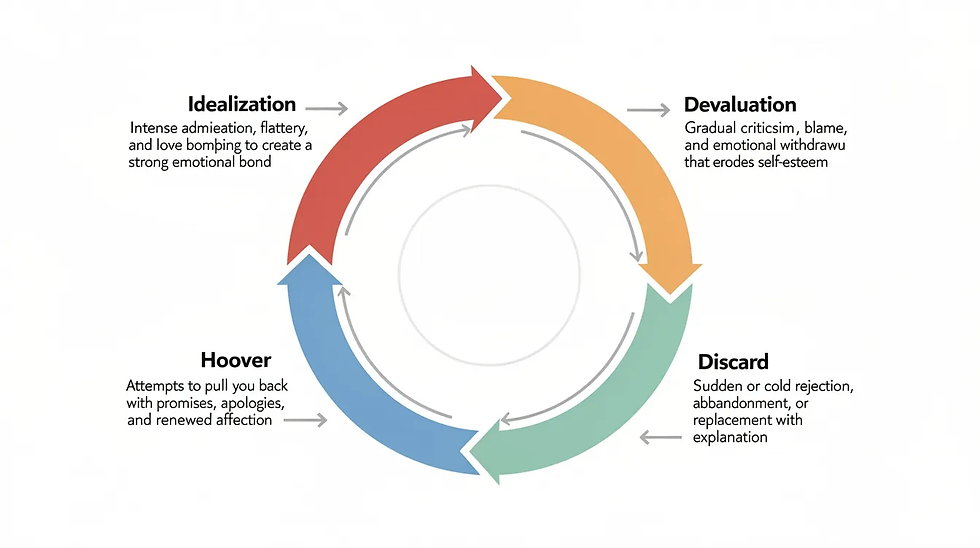
Named after the vacuum brand, this stage “sucks” the victim back in
Returns with renewed love bombing, apologies, or promises to change
May occur weeks, months, or even years after the discard
Designed to regain narcissistic supply and control
Narcissistic relationships often begin with a phase of love bombing, where the narcissist showers their partner with excessive affection and attention to create dependency. This isn’t genuine love—it’s strategic grooming. By creating intense attachment early, the narcissist ensures the victim will be more likely to rationalize later devaluation and stay in the relationship longer.
Common tactics during devaluation:
When the narcissist feels threatened or bored, the devaluation phase intensifies. Tactics include:
Gaslighting: Denying things that happened, telling you that you’re “too sensitive” or “crazy”
Projection: Accusing you of the exact behaviors they’re engaging in (cheating, lying, being selfish)
Moving goalposts: Whatever you do is never enough attention or good enough
Intermittent reinforcement: Random moments of the “old them” mixed with abuse, creating addiction-like attachment
Isolation: Cutting you off from friends and family who might offer perspective
Individuals in narcissistic relationships may experience a cycle of idealization followed by devaluation, which can lead to emotional abuse and manipulation. The cycle is designed—consciously or unconsciously—to keep the victim disoriented and dependent.
Impact on mental health:
Research indicates that 80% of narcissistic abuse survivors report significant anxiety and depression. The impact extends further:
Chronic confusion and self-doubt
Insomnia and hypervigilance
Symptoms consistent with complex PTSD
Difficulty trusting future partners
Erosion of personal identity—many survivors describe losing their former self
Emotional Whiplash is caused by the rapid shift from idolizing someone to viewing them with contempt, leading to intense distress, anxiety, and a sense of betrayal. Victims often describe feeling like they’re going crazy, which is precisely the point. When your reality is constantly questioned, you begin to doubt your own perceptions.
Idealization and Devaluation in Everyday Unhealthy Relationships
Not every unhealthy relationship involves a diagnosed personality disorder. Patterns of idealization and devaluation appear across a spectrum of relationships—and recognizing them doesn’t require applying clinical labels to people.
Everyone occasionally over-idealizes new friends, partners, or situations. Everyone experiences disappointment when reality doesn’t match expectations. The difference is degree and pattern. When extreme swings between “you’re amazing” and “you’re worthless” happen repeatedly, this signals an unhealthy relationship pattern regardless of diagnosis.
Examples beyond romantic relationships:
Friendships: A new friend who immediately treats you as their best friend, shares deep secrets, and wants constant contact—then abruptly turns critical, spreads gossip, or ghosts when you set a boundary
Workplace: A boss or mentor who initially praises your work excessively, then begins undermining you, taking credit for your ideas, or criticizing you publicly when you show independence
Family dynamics: A parent or sibling who alternates between treating you as the “golden child” and the scapegoat, often triggered by whether you’re meeting their expectations
Social groups: Communities that welcome newcomers with overwhelming enthusiasm, then enforce rigid conformity and shun anyone who questions group norms
Toxic relationships can emerge from the patterns of idealization and devaluation, causing unstable dynamics and long-term damage to trust. The common thread is the lack of consistency and the conditional nature of the regard—you’re only valued when you’re serving a specific function.
Behavior over labels:
When evaluating whether a relationship is healthy, focus on behavior patterns rather than trying to diagnose the other person. Ask yourself:
Does this person treat me consistently, or do I never know which version I’ll get?
Can I express concerns without being dismissed, attacked, or shut out?
Do I feel safe being my authentic self, or do I adapt my behavior to manage their reactions?
Does this relationship make me feel better or worse about myself over time?
Am I isolated from other relationships because of this one?
Look for patterns over time and across contexts rather than judging a single bad day or isolated conflict. One argument doesn’t mean abuse. But if the cycle of being put on a pedestal and then knocked down repeats consistently, that’s showing signs of a deeper problem.
Cultural factors:
Social media and modern dating culture can amplify idealization and quick disillusionment. Highlight reels create unrealistic expectations. Hookup culture encourages rapid intimacy without the foundation building that comes with slower relationship development. A 2024 Hinge survey found that 30% of daters report experiencing love bombing—suggesting these patterns are widespread, especially those navigating online dating in the 2020s.
This doesn’t excuse the behavior, but it provides context. In a culture that rewards intensity and punishes “taking things slow,” idealization-devaluation dynamics can feel normalized even when they’re harmful.
Self-Idealization and Self-Devaluation
The same splitting that affects how we see others can turn inward, creating destructive patterns in how we view ourselves. Self-idealization and self-devaluation are two sides of the same coin, and both destabilize self esteem and identity.
Self-idealization involves phases of feeling invincible, superior, or “finally fixed.” During these periods, you might:
Take on unsustainable commitments believing you can handle anything
Ignore warning signs of burnout because you feel unstoppable
Make risky decisions based on inflated confidence
Dismiss feedback or concerns from others
Feel like you’ve finally “figured it out” after years of struggle
The problem is that these grandiose self-perceptions set up inevitable crashes. No one can maintain perfection, and when mistakes happen—as they always do—the swing to self-devaluation begins.
Self-devaluation brings intense self-criticism, hopelessness, and global negative judgments. Signs include:
Labeling yourself as a “complete failure” after minor setbacks
Believing you’re fundamentally broken or unlovable
Ruminating on past mistakes while ignoring accomplishments
Feeling like an imposter despite evidence of competence
Spiraling into depression after rejection or criticism
Self-Esteem Instability occurs when splitting is directed inward, resulting in highly unstable self-esteem that fluctuates based on perceived successes or failures. One day you feel confident; the next, you feel worthless. This instability is exhausting and makes it nearly impossible to maintain a consistent sense of who you are.
Identity Confusion makes it difficult to maintain a consistent sense of self and can result in feelings of shame and confusion about true feelings and values. When your self-worth depends entirely on external feedback or your latest performance, you lose touch with a stable core identity.
Connection to anxiety and perfectionism:
This inner idealization-devaluation cycle fuels anxiety, depression, perfectionism, and burnout. The pattern is especially common in high-pressure environments—demanding careers, competitive academic programs, and the constant comparison culture of social media. The cycle of shifting between extreme positive and negative views acts as an emotional rollercoaster, leading to several psychological consequences. These include:
Chronic anxiety about maintaining the “good” version of yourself
Avoidance of challenges for fear of triggering self-devaluation
Procrastination driven by fear of not being perfect
Difficulty accepting compliments or criticism realistically
Noticing these extremes in self-talk is a key step toward seeking therapy and practicing more balanced, compassionate self-perception. If you swing between feeling like you can conquer the world and feeling like a worthless failure, this pattern deserves attention.
Warning Signs You’re Caught in an Idealization–Devaluation Cycle
Early recognition of warning signs can prevent deeper entanglement in narcissistic abuse or other toxic dynamics. The sooner you identify the pattern, the better positioned you are to protect yourself.
External warning signs (in the relationship):
Warning Sign | What It Looks Like |
Rapid love bombing | Excessive affection, gifts, and attention in early stages |
Pressure for fast commitment | Talk of exclusivity, moving in, or marriage within weeks |
Intensity that feels overwhelming | Constant contact, grand gestures that feel more possessive than romantic |
Walking on eggshells | Monitoring your behavior to avoid triggering their anger or withdrawal |
Frequent breakups and reconciliations | Dramatic endings followed by passionate reunions |
Feeling like the relationship defines your worth | Your self-esteem rises and falls based on how they’re treating you |
Isolation from other relationships | Gradual distancing from friends and family |
Inconsistency between words and actions | Promises that never materialize, apologies without change |
Internal warning signs (in yourself): |
Chronic confusion about where you stand in the relationship
Ruminating about what you did wrong to cause the shift
Minimizing your own needs to keep the peace
Feeling ashamed to tell friends or family the full story
Making excuses for behavior you wouldn’t accept from anyone else
Feeling like you’re losing your mind or can’t trust your own perceptions
Physical symptoms: anxiety, insomnia, stomach issues, chronic tension
One sign alone doesn’t prove abuse. But when you begin noticing a cluster of these patterns over weeks or months, that’s a serious red flag. Trust your instincts—if something feels wrong, it probably is. The cycle of idealization and devaluation can create significant challenges in maintaining relationships, as individuals may feel confused and hurt by the sudden shifts in perception from being idealized to devalued. If you’re experiencing this confusion, you’re not imagining it.
When to seek help:
Talk with trusted friends, family, or a mental health professional when you notice these patterns. This is especially important if:
You feel unsafe physically or emotionally
You’ve become isolated from your support network
You’re experiencing symptoms of anxiety, depression, or trauma
You find yourself unable to leave despite recognizing the harm
The other person has threatened you, your children, or themselves
You don’t have to figure this out alone, and you don’t have to wait until things “get really bad” to deserve support.
How Idealization–Devaluation Affects Mental Health
Repeated exposure to idealization and devaluation cycles creates lasting emotional consequences. Understanding these effects helps validate what you’re experiencing and motivates seeking appropriate help.
These patterns can profoundly destabilize personal mental health and self-esteem by preventing a balanced, realistic understanding of oneself and others. When your worth fluctuates based on someone else’s unstable perceptions, maintaining a stable sense of self becomes nearly impossible.
Common mental health effects:
Effect | Description |
Low self-esteem | Chronic self-doubt after repeated devaluation |
Anxiety | Hypervigilance about triggering the next negative episode |
Depression | Hopelessness about the relationship and about yourself |
Chronic stress | Elevated cortisol from ongoing unpredictability (research shows increases of 50% or more) |
Complex PTSD symptoms | Emotional flashbacks, dissociation, difficulty trusting |
Cognitive dissonance | Mental exhaustion from holding contradictory beliefs |
Emotional instability, anxiety, and relationship destruction are severe impacts of idealization and devaluation, especially in the context of personality disorders or narcissistic abuse. Survivors often describe feeling fundamentally changed by these experiences—as if they’ve lost their former self. |
Cognitive dissonance:
One of the most confusing aspects is holding conflicting beliefs simultaneously. You know they’ve hurt you. You also love them. You know the relationship is unhealthy. You also remember how amazing the idealization phase felt. This tension creates intense mental fatigue and keeps people stuck.
The brain naturally seeks consistency. When reality contradicts your beliefs about a relationship, something has to give. Often, victims resolve the dissonance by blaming themselves (“if I were better, they wouldn’t treat me this way”) rather than accepting that the other person’s behavior is the problem.
Trauma bonding:
Trauma bonding describes the powerful attachment that forms when periods of abuse are mixed with intermittent affection and apology. This isn’t weakness—it’s biology. The unpredictable reward pattern (sometimes love, sometimes cruelty) creates the same neurochemical response as addiction.
Persistent Disappointment arises from idealization that sets the stage for inevitable disillusionment, resulting in feelings of hopelessness and isolation. Each time the cycle repeats, hope builds during idealization and crashes during devaluation. Over time, this pattern can fundamentally alter how someone views relationships, themselves, and the world.
It’s not your fault:
None of these responses mean the survivor is weak or broken. They are normal human reactions to prolonged, inconsistent treatment. Your brain adapted to an abnormal situation using the tools it had available. Healing means learning new tools and rewiring those adaptations.
Evidence-Based Treatments and Coping Strategies
Here’s the hopeful truth: both people who engage in idealization-devaluation patterns and those affected by them can experience meaningful recovery with appropriate help. Change is possible.
Key therapeutic approaches:
Dialectical Behavior Therapy (DBT)
Originally developed by Marsha Linehan for treating borderline personality disorder, DBT has proven highly effective for managing splitting and emotional dysregulation. Studies show 70-80% symptom reduction for people who complete the program.
DBT focuses on four skill areas:
Mindfulness: staying present and aware of intense emotions
Distress tolerance: surviving crises without making things worse
Emotional regulation: understanding and managing emotions
Interpersonal effectiveness: communicating needs and maintaining relationships
Dialectical Behavior Therapy (DBT) and Cognitive Behavioral Therapy (CBT) are therapies that can help manage the distortions associated with splitting. These approaches work because they target the specific cognitive and emotional patterns that drive idealization-devaluation cycles.
Cognitive Behavioral Therapy (CBT)
CBT helps identify and challenge the extreme thoughts that underlie splitting. Research indicates approximately 60% efficacy in reducing symptoms. Through CBT, individuals learn to:
Recognize all-or-nothing thinking patterns
Test beliefs against evidence
Develop more balanced, realistic perspectives
Build coping strategies for emotional triggers

Other supportive approaches:
Trauma-focused therapies (EMDR, somatic experiencing) for processing past wounds
Group therapy for shared support and reality-checking
Psychoeducation on attachment patterns and personality dynamics
Couples therapy (only if both partners are genuinely committed to change—not recommended if abuse is ongoing)
Coping strategies for survivors:
If you’re recovering from a relationship marked by these dynamics, consider:
Journaling: Document actual behaviors versus promises. This creates a reality check when cognitive dissonance makes things fuzzy.
Reality-checking: Share your experiences with trusted people who can offer outside perspective.
Boundary setting: Learn what boundaries you need and practice enforcing them.
Rebuilding social networks: Reconnect with friends and family you may have been isolated from.
Self-care basics: Sleep, nutrition, and movement matter more than pampering—they restore baseline functioning.
Practicing mindfulness can help individuals notice the shifts in their emotions and perceptions, enabling them to recognize contradictory evidence. When you can observe thoughts without immediately acting on them, you create space for more balanced responses.
Finding professional help:
Seek a licensed mental health professional with experience in trauma, abuse dynamics, or personality disorders. Options include:
Traditional in-person therapy
Teletherapy (access increased 300% post-COVID)
Community mental health centers with sliding scale fees
Support groups for abuse survivors
If there is any risk of physical violence, safety planning must be the immediate priority. This may include contacting domestic violence hotlines, creating an exit plan, and working with professionals experienced in dangerous situations.
Practical Steps to Break Free from the Idealization–Devaluation Cycle
If you’re currently in an unhealthy relationship or recently out of one, these action-oriented steps can help you begin reclaiming your life.
Immediate steps:
Document incidents. Keep a private record of specific behaviors—dates, what was said, what happened. This serves multiple purposes: reality-checking for yourself, evidence if legal protection becomes necessary, and material for therapy.
Confide in trusted allies. Break the isolation. Share what’s happening with people who care about you. Their outside perspective can counter gaslighting and provide emotional support.
Contact a therapist. Early intervention makes recovery smoother. Don’t wait until things “get bad enough” to deserve help.
Assess safety. If there’s any risk of physical violence or escalation, connect with domestic violence resources. Approximately 20% of emotionally abusive relationships escalate to requiring legal protective measures.
Establishing boundaries:
Limit or cut contact if the relationship is ongoing
Block on social media and communication platforms
Resist hoovering attempts—the sudden apologies, renewed love bombing, or promises to change
Avoid the temptation to “get closure” through confrontation (rarely provides what you’re seeking)
Self-care as restoration:

Self-care in this context isn’t about bubble baths and face masks. It’s about:
Sleep: Prioritizing rest to support nervous system recovery
Nutrition: Eating regularly, even when appetite is affected
Movement: Physical activity that feels manageable, not punishing
Routine: Small daily structures that restore a sense of normalcy and agency
Boundaries: Protecting your time and energy as you heal
Expectations for recovery:
Breaking trauma bonds and ingrained patterns happens slowly—typically over months, not days. Research indicates recovery from idealization-devaluation relationships averages 6-18 months with consistent therapy and support.
Setbacks are part of recovery, not proof of failure. You might miss them. You might doubt yourself. You might be tempted to return. These experiences don’t erase your progress—they’re part of the process of rewiring patterns that took years to develop.
Recovery is possible. Thousands of people have walked this path before you and emerged into healthier relationships and stronger senses of self. You can too.
Frequently Asked Questions (FAQ)
Can a relationship with idealization and devaluation ever become healthy?
Relationships can change, but change requires both people to recognize the problem and commit to consistent, long-term treatment and behavioral modification. For someone with entrenched patterns—especially those rooted in personality disorder structures—this typically means years of intensive therapy, not just apologies or promises.
Research suggests success rates for relationships marked by narcissistic abuse are below 20% even when both partners pursue therapy. The dynamics of power and manipulation often prevent genuine accountability.
More importantly, survivors are not obligated to wait for change. Prioritizing your own safety and mental health often means leaving, especially when there’s a history of manipulation or violence. Your healing doesn’t depend on their transformation. If you’re uncertain about what to do, discussing your specific situation with a therapist can help you think through options without the pressure of making immediate decisions.
Is idealization and devaluation always a sign of narcissistic personality disorder?
No single behavior or pattern can diagnose a personality disorder. Only qualified clinicians using comprehensive assessment can make such determinations. Idealization and devaluation appear across a range of conditions, including borderline personality disorder, other personality disorders, and in generally unhealthy relationship patterns without any formal diagnosis.
What matters most isn’t labeling the other person but understanding how their behavior affects your safety, respect, and mental health. Someone can cause significant harm without meeting criteria for any diagnosis. Equally, someone with a diagnosis can be in treatment and working hard to change their patterns.
Focus on what’s happening in the relationship rather than trying to diagnose from a distance. Document behaviors, assess impact, and seek professional guidance if you need help making sense of what you’re experiencing.
What if my parent has been idealizing and devaluing me since childhood?
Experiencing this cycle from a parent creates particularly deep wounds because it shapes a child’s earliest views of self-worth, relationships, and trust. Children naturally look to parents as mirrors—when that mirror distorts reality, it affects core identity formation.
Adult children of parents with these patterns benefit from working with therapists familiar with complex trauma and family-of-origin issues. Approaches like EMDR, internal family systems, or psychodynamic therapy can help process experiences that conventional talk therapy might not reach.
Setting limits with parents—including low or no contact—is sometimes necessary for healing. This is a deeply personal and often gradual decision. Some people maintain limited contact with strong boundaries; others need complete separation to break the cycle. There’s no single right answer, and you’re not obligated to maintain a relationship that continues to harm you simply because someone is family.
Does narcissistic abuse always include love bombing at the start?
Many narcissistic abuse cycles begin with obvious love bombing—the overwhelming attention, affection, and future-faking described throughout this article. However, some relationships start more subtly, especially in contexts where intense romance isn’t the norm.
In family relationships, the “bombing” might look like preferential treatment, excessive praise, or being designated the “golden child.” In workplace dynamics, it might appear as unusual mentorship attention or promises of rapid advancement. The pattern is less about grand romantic gestures and more about creating attachment and dependency.
The core issue is the ongoing pattern of manipulation, entitlement, and lack of empathy—not just the presence or absence of dramatic early gestures. Pay attention to how you feel over time: do you feel safe, respected, and seen as a whole person? Or do you feel confused, controlled, and diminished?
How long does it take to recover from an idealization–devaluation relationship?
Recovery timelines vary widely depending on several factors:
Severity and duration of the abuse: Longer, more intense experiences typically require more healing time
Presence of social support: Strong connections speed recovery
Access to trauma-informed therapy: Professional help makes a significant difference
Personal history: Those with prior trauma may need more comprehensive support
Some people feel significant relief within months of leaving the relationship. Deeper healing of patterns and trauma bonds often takes longer—research suggests 6-18 months as a typical range with consistent therapy and support.
Progress is rarely linear. You might have setbacks, moments of doubt, or periods when the old patterns feel stronger. This doesn’t mean you’re failing—it means you’re human. The brain takes time to rewire, especially when patterns were reinforced over years.
The most important point: seeking help early—rather than waiting until things “get really bad”—makes recovery smoother. You deserve support from the moment you recognize something is wrong, not just after you’ve hit bottom.
Conclusion: Moving Toward Safer, More Stable Connections
The idealization and devaluation cycle represents one of the most confusing and damaging patterns in relationships. Whether rooted in narcissistic abuse, borderline personality disorder, or simply unhealthy dynamics without formal diagnosis, this cycle erodes self-worth, creates trauma bonds, and leaves people questioning their own reality.
Understanding how this defense mechanism works—and recognizing the devaluation stage for what it is—helps you spot warning signs earlier, protect your mental health more effectively, and choose relationships based on consistency rather than intensity. The initial rush of being idealized feels intoxicating, but sustainable relationships are built on steady regard, not extreme highs and lows.
If you recognize these patterns in your life—whether in how you’re treated by others or in how you relate to yourself and those around you—compassionate, evidence-based mental health support is available. Therapies like DBT and CBT offer concrete tools for change. Recovery communities provide validation and hope. And simple steps like documenting reality, confiding in trusted people, and prioritizing basic self-care can begin shifting the trajectory.
Breaking free from these cycles takes time. Setbacks happen. But with insight, boundaries, and professional help, it is absolutely possible to heal from past harm and build more secure, balanced connections in the future. You deserve relationships where you’re seen as a whole human being—not a pedestal to be worshipped or a target to be torn down.